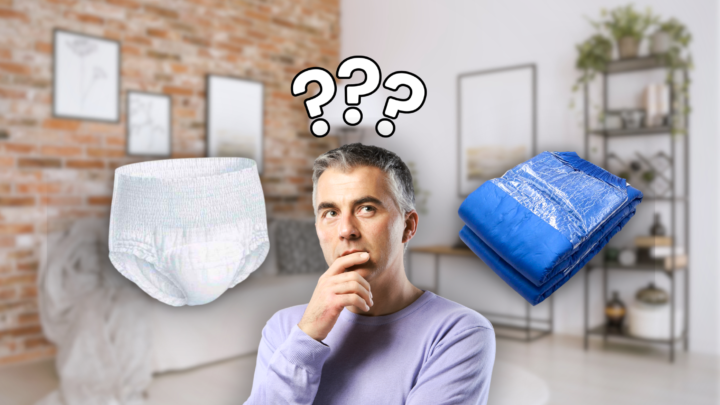
If you’ve spent ten minutes on a bedwetting product website and come away more confused than when you started, you’re not alone. The terminology used across incontinence products — pull-ups, briefs, nappies, pads, slips, pants, shields — is inconsistent, overlapping, and occasionally misleading. Different brands use different words for the same thing. The same word can mean entirely different products depending on who’s selling it. This plain-English guide cuts through the jargon so you can find what you need without second-guessing every label.
Why the Terminology Is So Confusing
Incontinence products span a wide market: babies, toddlers, children, teenagers, adults, and people with complex care needs. The language has evolved unevenly across those markets, with manufacturers borrowing terms from babycare, adapting medical terminology, and inventing brand-specific names that don’t translate elsewhere.
For parents managing bedwetting, the confusion is compounded by the fact that children’s and adult products overlap — a twelve-year-old may well need something designed for the adult continence market, and the terminology there is quite different to what’s on the packaging of Drynites.
The Core Product Categories, Explained
Pull-Ups (also called: training pants, pant-style briefs, pants)
A pull-up is an absorbent product shaped like underwear — it pulls up and down at the waist, like pants. The waistband and leg openings are elasticated. The absorbent core is built into the garment itself.
In the children’s market, examples include Drynites (from Huggies) and Goodnites. In the adult market, pull-ups are sometimes called pant-style briefs, pull-up pants, or simply pants (Tena Pants, Molicare Mobile, Lille Suprem Pants).
Pull-ups are the most commonly used overnight product for children with bedwetting. They’re discreet, quick to change, and manageable independently. The trade-off is that pull-up designs have real limitations overnight — particularly around leakage when a child is lying down. If you’ve been dealing with persistent leaks, this explanation of why overnight pull-ups leak covers the structural reasons in detail.
Briefs / Taped Briefs (also called: nappies, slips, all-in-ones)
A taped brief is a flat absorbent pad with side panels and adhesive (or Velcro) tabs that fasten at the waist. It doesn’t pull up — it wraps around the body and fastens at the sides, similar to a baby’s nappy.
You’ll see these called:
- Briefs (most common adult term)
- Slips (particularly from European brands like Molicare, Tena, Abena)
- Nappies (informal, commonly used by parents of children who need this level of containment)
- All-in-ones (AIOs — especially in the reusable market)
- Open briefs (to distinguish from pull-up / pant-style products)
Taped briefs typically offer higher absorbency than pull-ups and better leak containment — particularly for side and back leaks during sleep, because the fit can be adjusted precisely at the waist. Brands include Tena Slip, Molicare Slip, Abena Abri-Form, and Pampers Bed Mats (though Pampers uses its own terminology).
These products carry an unfair stigma that has no bearing on their suitability. When pull-ups aren’t containing overnight wetting, a taped brief is a practical next step — not a regression, and not something to apologise for.
Pads (also called: inserts, boosters, shields, liners)
The word “pad” is used for several quite different things, which is part of the confusion.
- Absorbent pad / insert / booster pad: A separate absorbent layer placed inside a pull-up or brief to increase capacity. It doesn’t have waterproof backing and won’t work alone — it sits inside another product. Useful when a pull-up is nearly sufficient but leaks near morning.
- Bed pad / bed mat: A waterproof-backed absorbent sheet placed on top of the mattress (or on top of bedding). This is a bed protection product, not a worn product. Brands include Kylie, Aidapt, and various own-brand options.
- Shields / liners: Very light absorbency pads designed for adult light urinary leakage — not relevant for overnight bedwetting in children but sometimes encountered in general incontinence aisles.
If someone recommends a “booster pad” for your child’s overnight pull-up, they mean the insert type. This can genuinely help if the pull-up is the right fit but runs out of capacity. For a fuller picture of how booster pads interact with pull-up design, see this guide on combining absorbent cores with pull-up formats.
Mattress Protectors and Waterproof Covers
These aren’t worn products — they protect the sleep surface. They come in several forms:
- Mattress protector: Fits over (or under) the mattress like a fitted sheet. Usually waterproof-backed. A baseline for any bedwetting situation.
- Waterproof bed pad / draw sheet: Laid across the middle of the bed. Quicker to change at night than a full sheet set. Can be used alongside a mattress protector.
- Waterproof duvet cover / pillow protector: Relevant where wetting reaches the bedding — more common with higher-volume wetting or when a worn product has leaked.
Bed protection and worn products aren’t either/or. Many families use both — a pull-up or brief on the child, plus a waterproof pad on the bed, as a belt-and-braces approach on high-wetting nights.
Terms You’ll See on Packaging That Don’t Mean Much
“Overnight” or “Night-Time”
There’s no regulated definition of “overnight” in product labelling. A product marketed as overnight may have the same core as the daytime version, or it may have a marginally larger absorbent panel. The label doesn’t guarantee it will last a full night of heavy wetting. This article looks at how overnight-labelled pull-ups are actually designed — and the gap between the label and the reality.
Absorbency Ratings (drops, ml, stars)
Manufacturers use different rating systems — drops, millilitres, stars, numbers — and there’s no standardisation between brands. A “4-drop” product from one brand is not directly comparable to a “4-drop” from another. Treat these as rough relative guides within a single brand’s range, not as cross-brand comparisons.
“All-Night Protection” and Similar Claims
Marketing language. Evaluate against your child’s actual wetting volume and sleep position, not the packaging claim. A child who wets heavily or sleeps prone may exceed the capacity of any pull-up, regardless of what the box says.
Size and Fit Terms
Sizing is inconsistent across brands. Weight ranges are the most reliable guide (e.g. 17–30 kg), but even these overlap between sizes. Key things to check:
- Waist measurement: More reliable than weight alone for older or differently proportioned children
- Leg opening size: Particularly important for leak prevention — too loose and leaks happen at the leg, too tight and you get red marks and discomfort
- Rise (front-to-back length): Rarely listed on packaging but affects fit, especially for taller children
For ASD and sensory-sensitive children, fit also includes texture, noise (rustling), bulk between the legs, and waistband feel. These are legitimate product criteria, not secondary concerns. If sensory tolerance is a factor in your household, it’s worth sampling before committing to a bulk purchase.
Reusable vs Disposable
Both categories use the same underlying terminology — pull-up, brief, pad — but reusable products have their own additional vocabulary:
- Wrap / cover: The waterproof outer shell in a two-part reusable system
- Insert: The absorbent inner component, used with a wrap
- All-in-one (AIO): A reusable product where the waterproof layer and absorbent core are integrated — directly equivalent to a disposable pull-up or brief in structure
- Pocket nappy: A waterproof shell with a pocket for an absorbent insert — common in baby products, less so for older children
Reusable products for older children and teenagers are a smaller market, but they exist. They’re worth considering for environmental or cost reasons, though absorbency for high-volume overnight wetting is harder to achieve in reusables than disposables.
A Quick Reference Summary
- Pull-up / pant / training pant: Worn product, pulls up like underwear, integrated absorbent core
- Brief / slip / taped brief / open nappy: Worn product, fastens with tabs at the sides, higher containment
- Booster / insert / booster pad: Goes inside a worn product to add absorbency — not a standalone product
- Bed pad / draw sheet / bed mat: Lies on the bed surface — protects bedding, not worn
- Mattress protector: Covers the mattress — bed protection, not worn
- All-in-one (AIO): Reusable equivalent of a pull-up or brief
Where to Go From Here
Understanding the terminology is the first step, but finding the right product for your child depends on their wetting volume, sleep position, age, build, and — if sensory needs are a factor — tolerance for different materials and fits. If overnight leaks are the central problem, the guide to front, back, and leg leak patterns is a practical next read: it maps leak location to likely causes and points toward which product features to prioritise.
If you’re managing bedwetting in a child where emotions are also running high — yours or theirs — this piece on managing bedwetting stress as a family covers the practical side of keeping things sustainable.
The right incontinence product is simply the one that works for your child, night after night. Knowing what the labels actually mean gets you there faster.