The Malem wearable bedwetting alarm is one of the most widely recommended products in its category — stocked by the NHS, endorsed by ERIC (the Children’s Bowel and Bladder Charity), and used by families across the UK for decades. If you’re considering an alarm as a treatment route, this review covers what the Malem actually does, how it performs in practice, and who it suits — and who it probably doesn’t.
What Is the Malem Wearable Bedwetting Alarm?
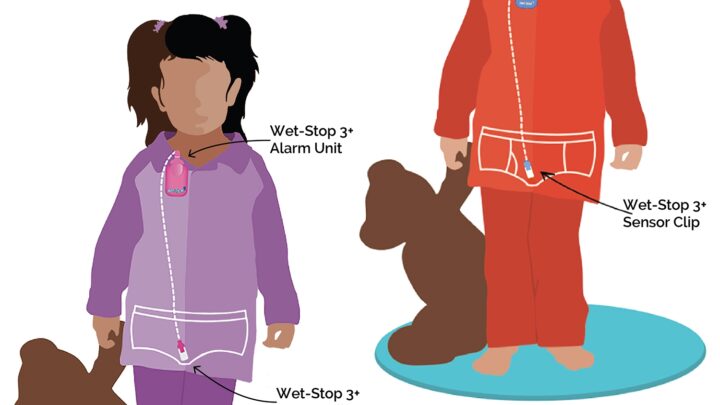
Malem is a British brand that has manufactured bedwetting alarms since the 1980s. Their flagship product is a wearable, clip-on alarm unit that attaches to pyjama clothing near the shoulder. A thin sensor wire runs down to a clip that fastens to the underwear or pad. When moisture is detected — at the very start of urination — the alarm triggers, waking the child so they can stop the flow and go to the toilet.
This is the core mechanism of all standard bedwetting alarms, and Malem’s implementation is considered among the most reliable. The alarm is designed for repeated nightly use over an 8–12 week conditioning period.
Variants Available
- Malem Ultimate: Single-tone alarm, the simplest and most affordable option
- Malem Ultimate Selectable: Allows choice of eight different tones and vibration — useful for children who habituate to a single sound
- Malem MO4: Multiple tone and vibration settings with louder volume output
- Malem MO3 (vibrating only): Silent vibration for children who share rooms, or where noise is a concern
Prices range from approximately £45 to £75 depending on model. Some NHS continence services loan Malem alarms free of charge — worth checking before purchasing.
How the Malem Alarm Works in Practice
Setup
The unit clips to a pyjama top near the collar or upper chest. The sensor attaches to the inside front of the underwear (or a pad, if one is being used). The cable between them is long enough to allow movement without pulling free, but light sleepers may dislodge it. Malem supplies replacement sensors, which is worth noting — the sensor is the component most likely to need replacing after extended use.
The Conditioning Process
Bedwetting alarms work through a process of conditioned arousal: over weeks of consistent use, the brain learns to associate bladder fullness with waking before voiding occurs. NICE guidelines recommend alarms as a first-line treatment for nocturnal enuresis in children aged seven and over, and clinical evidence supports their effectiveness — with around 65–70% of children achieving 14 consecutive dry nights after a full course of alarm therapy, though relapse rates exist.
The Malem alarm’s role is simply to trigger reliably at the right moment. It does that well. Success depends far more on consistent use over the full recommended period and on parental support than on which specific alarm model is chosen.
Volume and Wake Response
The Malem is loud — deliberately so. Most children with bedwetting are deep sleepers, and a quiet alert will not rouse them. In practice, many parents report that they wake before the child does and need to go in to help the child respond to the alarm. This is normal, particularly in the early weeks. If your child consistently sleeps through it, that isn’t a product failure — it’s a known feature of deep-sleep bedwetting. See My Child Sleeps Through the Bedwetting Alarm: Every Strategy That Can Help for specific approaches.
Malem Alarm: What Works Well
- Sensor reliability: Triggers quickly and consistently with minimal false alarms from sweat or humidity (though false alarms from heavy sweat do occasionally occur — this is a category-wide issue, not Malem-specific)
- Build quality: Robust, well-made unit with a reputation for lasting through a full treatment course and beyond
- Multiple alert options: The Selectable and MO4 models allow rotating sounds, which can help maintain the child’s response over weeks of use
- NHS-endorsed: Recommended by ERIC and used in NHS continence programmes — not a gimmick product
- Replacement parts available: Sensors and cables sold separately, extending the product’s usable life
- Small and discreet: The clip unit is compact and does not significantly disrupt sleep positioning
Limitations and Honest Caveats
- Not suitable under age seven: NICE guidance suggests alarm therapy is generally not appropriate before this age. It also requires a degree of maturity and motivation from the child to engage with the process.
- Requires consistent parental support: This is a significant time commitment, particularly in the first four weeks. If the household is already stretched, an alarm programme can add pressure. I Am Exhausted From Night Changes covers how other families manage this.
- Wire can detach: Some children move significantly in their sleep and dislodge the sensor connection. This means missed triggers on those nights.
- Not effective for all children: Around 30–35% of children do not achieve dryness from alarm therapy alone, and results can take the full 12 weeks to appear. If you’ve already completed a full course without improvement, see We Have Used the Bedwetting Alarm for Eight Weeks and Nothing Has Changed.
- Noise disrupts households: If siblings share a room, or walls are thin, the alarm will affect the whole family. The vibration-only MO3 model addresses this, but removes the auditory wake cue.
Who the Malem Alarm Is Well-Suited For
The Malem works best for children aged seven and over who wet regularly, have no underlying medical reason for bedwetting, and where the family can commit to the full treatment period. It is a conditioning tool, not a quick fix — and it works in line with what the evidence says alarms can achieve.
Children who are motivated to be dry, who are light-to-moderate sleepers, and whose bedwetting is primary nocturnal enuresis (never reliably dry, no daytime symptoms) tend to respond best.
ASD and Sensory Considerations
Some children with sensory sensitivities find the wire and clip uncomfortable or distressing. The Malem unit itself is small and light, which helps, but the sensor cable is an unavoidable tactile element. For children who cannot tolerate attached wearables, a wireless or mat-based alarm may be more appropriate. This is worth trialling in advance of a full commitment.
If the Alarm Isn’t Right Yet
Alarms aren’t the only route. If your child is younger, unwilling, or the alarm has already been tried without success, other options — including night-time protection, fluid management, and in some cases desmopressin — remain open. Understanding what causes bedwetting can help clarify which approach makes most sense for your child’s specific situation.
Malem vs Other Alarms: Brief Comparison
The main UK competitors to Malem are the Ramsey (Rodger Wireless) alarm, the DRI Sleeper, and budget clip alarms available online. Malem’s advantage is build quality, NHS recognition, and the availability of the selectable-tone variants. Wireless alarms remove the cable issue but add complexity. Budget alarms often have less reliable sensors and shorter lifespans.
If you’ve already tried one alarm without success, switching brand is unlikely to change the outcome — the limiting factor is usually the child’s sleep arousal threshold, not the alarm hardware. We Have Tried Two Different Alarms and Neither Has Worked covers what to consider next in that situation.
Verdict: Is the Malem Bedwetting Alarm Worth It?
For families ready to commit to an alarm programme — with a child of the right age and disposition — the Malem wearable bedwetting alarm is a reliable, well-built choice. It’s not the cheapest option, but it’s durable, widely trusted, and backed by clinical recommendation. It does what it’s designed to do.
What it can’t do is guarantee dryness on its own. Success requires consistent use, parental involvement, and a child whose bedwetting is responsive to conditioning. For families where that combination is in place, the Malem is as strong a starting point as any alarm on the UK market.
If you’re unsure whether an alarm is the right starting point for your family at all, Bedwetting by Age: What’s Normal, What’s Not, and What to Do gives a clearer picture of where different approaches tend to fit.