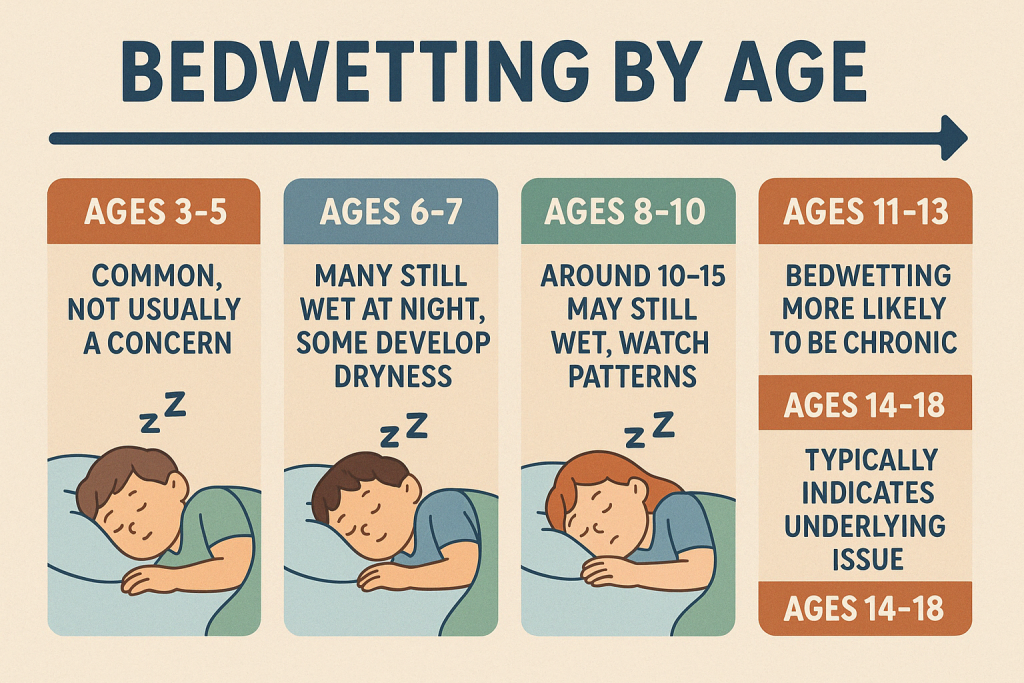
Bedwetting by age is one of the most searched topics by parents — and with good reason. Whether your child is 4 or 14, understanding what’s developmentally typical at their stage is the fastest way to work out whether you need to act, wait, or simply manage things more comfortably in the meantime. This guide covers the full age range, with clear signposts for when bedwetting is entirely normal, when it warrants a GP visit, and what practical steps are available at every stage.
What Is Bedwetting and Why Does It Happen?
Bedwetting — clinically known as nocturnal enuresis — is involuntary urination during sleep. It is not a behavioural problem, and it is not caused by laziness, deep sleep alone, or a child being difficult. The underlying mechanisms typically involve some combination of:
- Bladder capacity — smaller functional bladder volume overnight
- ADH production — insufficient antidiuretic hormone to reduce urine output during sleep
- Arousal threshold — the brain not reliably waking in response to bladder signals
- Genetics — bedwetting runs strongly in families; if both parents wet the bed as children, there is roughly a 77% chance their child will too
For a more detailed look at the biology, see What Really Causes Bedwetting? A Parent’s Guide to the Science.
Bedwetting by Age: What’s Typical at Each Stage
Ages 2–5: Not Yet Expected to Be Dry
Bladder control at night develops later than daytime dryness — often significantly later. Most children aged 2–4 are not neurologically ready to stay dry overnight, and expecting otherwise only creates unnecessary stress.
- Around 30% of 4-year-olds still wet the bed regularly
- At age 5, the figure is approximately 15–20%
- No intervention is recommended at this age — protection and patience are the appropriate response
What to do: A well-fitted pull-up or trainer pant overnight, combined with a waterproof mattress protector, handles this age group simply and without fuss. There is no clinical threshold for concern at this stage.
Ages 6–7: Common, But Worth Noting
Many children achieve night dryness between 5 and 7, but a significant proportion do not. At age 7, roughly 10% of children still wet the bed at least twice a week. This is common enough that it should not cause alarm — but if it is affecting sleep quality, confidence, or family life, it is entirely reasonable to start thinking about management strategies.
- Fluid management and a consistent bedtime toilet routine can help at this age
- Pull-ups remain appropriate and practical
- If there is daytime wetting alongside nighttime wetting, it is worth mentioning to a GP
What to do: No formal treatment is recommended before age 7. Focus on low-stress management — good protection, a calm approach, and language that doesn’t attach shame to accidents.
Ages 7–10: The Right Age to Consider Active Treatment
NICE guidance (CG111) recommends that children aged 7 and over who wet the bed regularly should be offered assessment and treatment — not because something is necessarily wrong, but because effective interventions exist and there is no benefit in delaying them indefinitely.
- At age 7–8, approximately 7–10% of children are still regularly wetting
- By age 10, this falls to around 5%
- First-line treatments at this age include bedwetting alarms and, where appropriate, desmopressin
What to do: If bedwetting is frequent (two or more nights per week), speak to your GP or health visitor. A referral to an enuresis clinic is appropriate and available. In the meantime, continue using protection — pull-ups, higher-absorbency options, or taped briefs if volume is heavy — to protect sleep quality while treatment is being pursued.
If the GP is not taking the concern seriously, see what to say to get a referral when the GP says “wait and see”.
Ages 11–13: Persistent Bedwetting Needs Proper Assessment
By early adolescence, bedwetting affects around 1–2% of children. At this age, it is far less likely to resolve on its own without intervention, and the emotional weight tends to increase — sleepovers, school trips, and growing self-awareness all make wet nights harder to navigate quietly.
- This age group is more likely to have primary nocturnal enuresis (never fully dry) with a physiological basis
- If secondary enuresis (dryness achieved then lost) has developed, a GP should investigate potential triggers
- Treatment is available and effective — alarm therapy has success rates of 60–70% when used correctly
What to do: If your child is not already under the care of an enuresis clinic, this is the age to push for a referral. Product management remains valid alongside treatment — pull-ups at this age are used by real families every night, and higher-capacity options exist for larger children. Signs it’s time to talk to a doctor covers the clinical red flags in more detail.
Ages 14–18: Specialist Involvement Is Warranted
Bedwetting in teenagers is less common — estimated at under 1% of adolescents — but it does occur, and it carries significant emotional weight. Teens are rarely forthcoming about the issue, and many manage it alone for years without telling parents or seeking help.
- At this age, underlying causes such as diabetes insipidus, urological abnormalities, sleep disorders, or neurological factors are more likely to be present and should be ruled out
- Secondary bedwetting in a teenager (previously dry) should always be assessed promptly
- Desmopressin can be effective, particularly for managing specific situations such as stays away from home
What to do: GP referral to a specialist — paediatric urologist, continence service, or relevant specialist depending on age — is the right step. Dignified, discreet product options (including adult-range absorbent underwear) are available and used by many older teenagers. The goal here is dignity and sleep quality as much as resolution.
Bedwetting by Age: Quick Reference
- Ages 2–5: Very common. No action needed beyond protection.
- Ages 6–7: Still common. Low-stress management. No treatment required before 7.
- Ages 7–10: Consider GP referral if frequent. Active treatment options available.
- Ages 11–13: Persistent wetting warrants enuresis clinic referral. Treatment is effective.
- Ages 14–18: Specialist assessment recommended. Rule out underlying causes.
What About Children With Additional Needs?
The developmental timelines above apply to neurotypical children. For children with autism, ADHD, cerebral palsy, or other conditions affecting development, bladder maturation may follow a different trajectory entirely. The same clinical thresholds do not always apply, and “waiting for it to resolve naturally” is often not the right framework.
For these children, the goal is frequently dignity, comfort, and sleep quality rather than progression toward dryness — and there is nothing wrong with that being the goal. Product selection for sensory-sensitive children warrants its own consideration: texture, noise, bulk, and material all affect whether a child will tolerate wearing something overnight.
Products at Every Age: What to Use and When
Regardless of age, appropriate protection reduces stress for the whole family — and poor sleep caused by wet nights has real consequences. The right product depends on the child’s size, the volume of wetting, their sensory tolerance, and how they feel about wearing something.
- Light or infrequent wetting: DryNites / Goodnites are widely available and a reasonable starting point
- Heavier or more frequent wetting: Higher-capacity pull-ups designed for overnight use offer better containment
- Significant volume or larger children: Taped briefs (such as Tena Slip or Molicare) provide the most reliable absorbency and are entirely appropriate — they are unfairly stigmatised relative to how well they actually work
- Bed protection alongside: A waterproof mattress protector is useful at any age, regardless of what the child wears
If you are struggling with leaks despite using pull-ups, the problem is often a design issue rather than the wrong size. See why overnight pull-ups leak for a more detailed explanation of why this happens and what can help.
When to See a GP: Key Indicators by Age
You do not need to wait for a specific age to raise bedwetting with a GP — but these are the clearest prompts:
- Child is 7 or older and wets two or more nights per week
- Bedwetting has returned after at least six months of dryness (secondary enuresis)
- There is daytime wetting alongside nighttime wetting
- The child is in pain or discomfort when they wet
- Bedwetting has suddenly worsened without explanation
- The child does not seem to feel anything when they wet
Any of the above warrants a GP conversation — and if you are not being heard, you are entitled to push further. See what to do when a GP dismisses your bedwetting concern.
The Bottom Line on Bedwetting by Age
Bedwetting is common in young children, decreases with age, and resolves naturally for most — but not all. The age at which it becomes worth actively treating is around 7, and by the teenage years, specialist input is appropriate. At every stage, the priority is the same: protect sleep, reduce stress, and act on the information available rather than waiting for something to change on its own.
If you are managing this night after night and feeling worn down, you are not alone — and practical strategies for avoiding burnout are worth reading alongside the clinical guidance.