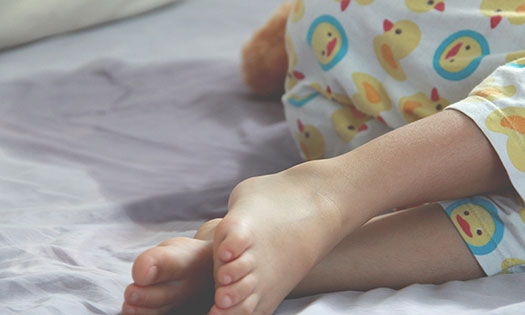
Most children who wet the bed don’t wake up when it happens. That’s normal. But if your child seems completely unaware — not just sleeping through it, but showing no reaction at all, even after lying in a wet bed for hours — you may be wondering whether something more is going on. It’s a reasonable question, and one worth looking at clearly.
Why Most Children Don’t Feel Themselves Wet
Bedwetting during sleep is, by definition, something that happens outside conscious awareness. The bladder empties during a sleep cycle — often deep NREM sleep — without the brain’s waking centres registering it. This is not a sign of laziness, defiance, or a problem with bladder sensation during the day.
Children who wet the bed typically have one or more of the following contributing factors:
- A bladder that is functionally smaller or more active overnight
- Reduced overnight production of ADH (antidiuretic hormone), meaning more urine is produced at night than the bladder can hold
- A sleep arousal threshold that is higher than average — meaning the brain does not respond to bladder signals during sleep
That third factor is the relevant one here. For children who don’t wake or stir at all, the arousal connection between the bladder and the brain is simply not yet established — or is less developed than average. This is well documented and is covered in more detail in our guide to the science behind bedwetting. It is not, in itself, a neurological red flag.
What “Not Seeming to Feel Anything” Can Look Like
There’s a spectrum here, and it matters which end your child sits on.
Common and expected
- Child sleeps through wetting entirely and doesn’t wake
- Child is unaware they’ve wet until morning or until they’re told
- Child has no memory of the event the next day
- Child doesn’t seem bothered by lying in wetness during the night
All of these are typical of nocturnal enuresis. The fact that a child doesn’t wake — and doesn’t feel the wetness pulling them out of sleep — is one of the defining features of the condition, not an outlier symptom.
Less typical and worth discussing with a doctor
- Child has no awareness of needing to urinate during the day either — poor daytime bladder sensation
- Child cannot tell when they are passing urine even when awake
- There is daytime wetting as well as overnight wetting, especially without any sense of urgency beforehand
- Child seems unaware of wetness even when awake — e.g., doesn’t notice damp clothing
- Wetting is accompanied by any other changes in sensation, movement, or bladder/bowel control
If your child’s lack of sensation extends into their waking hours — particularly if they don’t feel the urge to go, or don’t register that they’re wet when awake — that’s worth raising with your GP or paediatrician. It’s not necessarily serious, but it needs assessment. See our guide on when bedwetting is a problem and when to speak to a doctor for more on the signals that warrant a clinical conversation.
Daytime Wetting and Lack of Sensation: A Different Picture
If your child is wetting during the day as well as at night, and seems unaware in both contexts, this shifts the picture considerably. Daytime and nighttime wetting have different causes and implications, and daytime wetting without sensation is more likely to prompt clinical investigation.
Conditions that can affect bladder sensation and awareness include:
- Overactive bladder — contractions happen too quickly for the child to register urgency in time
- Underactive bladder — bladder overfills without sending strong signals
- Constipation — rectal loading can blunt bladder sensation and is extremely common in children with wetting problems
- Neurological differences — including spinal cord issues, tethered cord, or developmental conditions that affect nerve signalling to the bladder
- Autism and sensory processing differences — some autistic children have reduced interoceptive awareness, meaning they genuinely do not register internal body signals like bladder fullness in the same way
None of this is a reason to panic. But it is a reason to describe the full picture to a clinician rather than waiting it out.
Autism, ADHD, and Sensory Awareness of Wetting
For children with autism or ADHD, the picture around bedwetting sensation can be more complex. Interoception — the sense of what’s happening inside the body — is often different in autistic children. This isn’t the same as a physical nerve problem; it’s a processing difference. A child may not register bladder fullness, the sensation of warmth when wetting, or discomfort from wetness, not because there’s structural damage, but because their brain processes those signals differently.
This can mean:
- Greater difficulty with toilet training in general
- Wetting without appearing to notice, even when awake
- Reduced or absent distress about being wet — which is sometimes mistaken for indifference
In this context, “not seeming to feel anything” is not laziness or defiance. It may reflect genuine differences in how the body’s internal signals are perceived. If this resonates with your child’s wider profile, it’s worth discussing with whoever supports them — whether that’s a paediatrician, a community nurse, or a specialist team.
Pain When Wetting: The Opposite Problem
On the other end of the spectrum, some children experience discomfort or pain when they wet — which is a separate concern. If that applies to your child, our article on what pain when wetting could mean is the more relevant starting point.
What to Observe Before Seeing a GP
If you’re preparing for a GP appointment, it helps to come with specific observations rather than a general “they don’t seem to notice.” Consider noting:
- Does your child feel the urge to urinate during the day? Can they hold on if needed?
- Have you ever observed them wetting without awareness during waking hours?
- Do they notice when their clothing is wet or damp when awake?
- Is there any constipation, straining, or irregular bowel pattern?
- Has there been any change in their walking, balance, or lower limb sensation — even subtle?
- Are there any other differences in how they process physical sensations generally?
A GP who hears “my child wets the bed and doesn’t wake up” will likely offer reassurance. A GP who hears “my child doesn’t seem to register the need to urinate during the day either, and doesn’t notice being wet when awake” will — rightly — look at this differently. If you feel your concerns haven’t been heard, our article on what to do when the GP dismisses a bedwetting concern may help you navigate that conversation more effectively.
In the Meantime: Practical Containment
Regardless of what’s causing the unawareness, wet nights still need managing. If your child sleeps deeply through wetting and lies in wetness until morning, a higher-capacity product will reduce the chance of a saturated nappy causing leaks and skin irritation:
- DryNites / Goodnites are a reasonable starting point for lighter to moderate wetting
- Higher-capacity pull-ups (such as those designed for heavier overnight use) are better suited to children who produce large volumes overnight or who sleep for long stretches without any movement
- Taped briefs (such as Tena Slip or Molicare) offer the most secure containment and don’t rely on a snug fit to prevent leaks — entirely appropriate when containment is the goal
- Waterproof mattress protection as a back-up layer is always worth having regardless of the product used overnight
For children who are heavy sleepers and heavy wetters, saturation overnight is a real risk. If the product is full by the time your child wakes, it’s worth sizing up or switching format rather than assuming leaks are inevitable.
The Bottom Line
A child not feeling anything when they wet the bed overnight is, in most cases, a feature of bedwetting itself — not a separate problem. The brain simply isn’t registering the bladder signal during sleep. That is common, documented, and not a cause for alarm on its own.
Where it becomes worth investigating is when the lack of sensation extends into waking hours, when daytime wetting is also present, or when your child’s wider profile — including any neurodevelopmental differences — suggests a more complex picture of body awareness.
If you’re unsure which category your child falls into, describe exactly what you observe to your GP. Specifics matter here, and you know your child better than anyone.